| American Daylight Time | ||||||||||||||||||||||||||||||||||||
|---|---|---|---|---|---|---|---|---|---|---|---|---|---|---|---|---|---|---|---|---|---|---|---|---|---|---|---|---|---|---|---|---|---|---|---|---|
|
The Sunshine Protection Act | ||||||||||||||||||||||||||||||||||||
|
Current Proposals
S.29 - Sunshine Protection Act of 2025 - Introduced 1/7/2025 - Referred to the Committee on Commerce, Science, and Transportation - Approved by committee April 30th, 2025 (revote required due to attendance) [Press Release] - Discussed on the Senate Floor October 28th, 2025 (offered for Unanimous Consent) [Transcript] H.R.139 - Sunshine Protection Act of 2025 - Introduced 1/3/2025 - Referred to the House Committee on Energy and Commerce - Received in the Senate and Read twice and referred to the Committee on Commerce, Science, and Transportation on 7/15/2026 H.Res.1423 - Providing for consideration of the bill (H.R. 139) to make daylight savings time permanent, and for other purposes; - Rules committee advanced four bills to the floor for a vote including H.R. 139 under a closed rule that allowed a one hour debate - Resolution passed 7/14/2026 H.R.7389 - Motor Vehicle Modernization Act of 2026 - Introduced 2/6/2026 H.R.300 - Daylight Act - Introduced 1/9/2025 - Referred to the House Committee on Energy and Commerce H.R.1630 - To allow States to elect to observe year-round daylight saving time - Introduced 2/26/2025 - Referred to the House Committee on Energy and Commerce (This proposal is for permanent standard time with states allowed to opt-in to DST, seasonal or year long.) | ||||||||||||||||||||||||||||||||||||
Supporting States: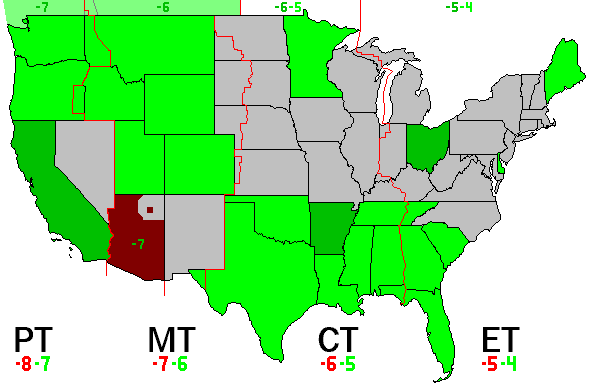 The 19 states marked in green have passed trigger laws to move to Permanent DST when allowed by the federal government. Arkansas and Ohio have passed measures encouraging Permanent DST. California voters approved moving to Permanent DST (when allowed). Canadian provinces in light green are observing Permanent DST (Saskatchewan since 1960, Alberta and British Columbia since 2026). Arizona has opted out of seasonal DST under the provisions of 15 U.S.C. §260a(a). Proposed Bill: To make daylight savings time permanent, and for other purposes. Be it enacted by the Senate and House of Representatives of the United States of America in Congress assembled, SECTION 1. Short title. SEC. 2. Making daylight savings time permanent.
Amended by Senate Committee on Commerce, Science, and Transportation to add: Resulting Changes:
It is the policy of the United States to promote the adoption and observance of uniform time within the standard time zones prescribed by sections 261 to 264 of this title, as modified by section 265 of this title. To this end the Secretary of Transportation is authorized and directed to foster and promote widespread and uniform adoption and observance of the same standard of time within and throughout each such standard time zone. (Pub. L. 89–387, §2, Apr. 13, 1966, 80 Stat. 107; Pub. L. 97–449, §2(c), Jan. 12, 1983, 96 Stat. 2439.) §260a. Advancement of time or changeover dates REPEALED (a) Duration of period; State exemption During the period commencing at 2 o'clock antemeridian on the second Sunday of March of each year and ending at 2 o'clock antemeridian on the first Sunday of November of each year, the standard time of each zone established by sections 261 to 264 of this title, as modified by section 265 of this title, shall be advanced one hour and such time as so advanced shall for the purposes of such sections 261 to 264, as so modified, be the standard time of such zone during such period; however, (1) any State that lies entirely within one time zone may by law exempt itself from the provisions of this subsection providing for the advancement of time, but only if that law provides that the entire State (including all political subdivisions thereof) shall observe the standard time otherwise applicable during that period, and (2) any State with parts thereof in more than one time zone may by law exempt either the entire State as provided in (1) or may exempt the entire area of the State lying within any time zone. (b) State laws superseded It is hereby declared that it is the express intent of Congress by this section to supersede any and all laws of the States or political subdivisions thereof insofar as they may now or hereafter provide for advances in time or changeover dates different from those specified in this section. (c) Violations; enforcement For any violation of the provisions of this section the Secretary of Transportation or his duly authorized agent may apply to the district court of the United States for the district in which such violation occurs for the enforcement of this section; and such court shall have jurisdiction to enforce obedience thereto by writ of injunction or by other process, mandatory or otherwise, restraining against further violations of this section and enjoining obedience thereto. (Pub. L. 89–387, §3, Apr. 13, 1966, 80 Stat. 107; Pub. L. 92–267, Mar. 30, 1972, 86 Stat. 116; Pub. L. 97–449, §2(c), Jan. 12, 1983, 96 Stat. 2439; Pub. L. 99–359, §2(b), July 8, 1986, 100 Stat. 764; Pub. L. 109–58, title I, §110(a), Aug. 8, 2005, 119 Stat. 615.) §261. Zones for standard time; interstate or foreign commerce (a) In general For the purpose of establishing the standard time of the United States, the territory of the United States shall be divided into nine zones in the manner provided in this section. Except as provided in section 260a(a) (b) of this title, the standard time of the first zone shall be Coordinated Universal Time retarded by 4 hours 3 hours; that of the second zone retarded by 5 hours 4 hours; that of the third zone retarded by 6 hours 5 hours; that of the fourth zone retarded by 7 hours 6 hours; that of the fifth zone retarded 8 hours by 7 hours; that of the sixth zone retarded by 9 hours 8 hours; that of the seventh zone retarded by 10 hours 9 hours; that of the eighth zone retarded by 11 hours 10 hours; and that of the ninth zone shall be Coordinated Universal Time advanced by 10 hours 11 hours. The limits of each zone shall be defined by an order of the Secretary of Transportation, having regard for the convenience of commerce and the existing junction points and division points of common carriers engaged in interstate or foreign commerce, and any such order may be modified from time to time. As used in sections 261 to 264 of this title, the term "interstate or foreign commerce" means commerce between a State, the District of Columbia, the Commonwealth of Puerto Rico, or any possession of the United States and any place outside thereof. (b) Standard time for certain States and areas. The standard time for a State that has exempted itself from the provisions of section 3(a) of the Uniform Time Act of 1966 (15 U.S.C. 260a(a)), as in effect on the day before the date of the enactment of the Sunshine Protection Act of 2025, pursuant to such section, or an area of a State that has exempted such area from such provisions pursuant to such section, shall be, as such State considers appropriate— (1) the standard time for such State or area, as the case may be, pursuant to subsection (a) of this section; or (2) the standard time for such State or area, as the case may be, pursuant to subsection (a) of this section as it was in effect on the day before the date of the enactment of the Sunshine Protection Act of 2025. (b) (c) Coordinated Universal Time defined In this section, the term "Coordinated Universal Time" means the time scale maintained through the General Conference of Weights and Measures and interpreted or modified for the United States by the Secretary of Commerce in coordination with the Secretary of the Navy. (Mar. 19, 1918, ch. 24, §1, 40 Stat. 450; Pub. L. 89–387, §4(a), Apr. 13, 1966, 80 Stat. 108; Pub. L. 97–449, §2(c), Jan. 12, 1983, 96 Stat. 2439; Pub. L. 106–564, §1(a), Dec. 23, 2000, 114 Stat. 2811; Pub. L. 110–69, title III, §3013(c)(3), Aug. 9, 2007, 121 Stat. 598.) (§262-§267 unchanged) §262. Duty to observe standard time of zones Within the respective zones created under the authority of sections 261 to 264 of this title the standard time of the zone shall insofar as practicable (as determined by the Secretary of Transportation) govern the movement of all common carriers engaged in interstate or foreign commerce. In all statutes, orders, rules, and regulations relating to the time of performance of any act by any officer or department of the United States, whether in the legislative, executive, or judicial branches of the Government, or relating to the time within which any rights shall accrue or determine, or within which any act shall or shall not be performed by any person subject to the jurisdiction of the United States, it shall be understood and intended that the time shall insofar as practicable (as determined by the Secretary of Transportation) be the United States standard time of the zone within which the act is to be performed. (Mar. 19, 1918, ch. 24, §2, 40 Stat. 451; Pub. L. 89–387, §4(b), Apr. 13, 1966, 80 Stat. 108; Pub. L. 97–449, §2(c), Jan. 12, 1983, 96 Stat. 2439.) §263. Designation of zone standard times The standard time of the first zone shall be known and designated as Atlantic standard time; that of the second zone shall be known and designated as eastern standard time; that of the third zone shall be known and designated as central standard time; that of the fourth zone shall be known and designated as mountain standard time; that of the fifth zone shall be known and designated as Pacific standard time; that of the sixth zone shall be known and designated as Alaska standard time; that of the seventh zone shall be known and designated as Hawaii-Aleutian standard time; that of the eighth zone shall be known and designated as Samoa standard time; and that of the ninth zone shall be known as Chamorro standard time. (Mar. 19, 1918, ch. 24, §4, 40 Stat. 451; Pub. L. 89–387, §4(c), Apr. 13, 1966, 80 Stat. 108; Pub. L. 98–181, title II, §2003(a), Nov. 30, 1983, 97 Stat. 1297; Pub. L. 106–564, §1(b), Dec. 23, 2000, 114 Stat. 2811.) §264. Part of Idaho in fourth zone In the division of territory, and in the definition of the limits of each zone, as provided in sections 261 to 264 of this title, so much of the State of Idaho as lies south of the Salmon River, traversing the State from east to west near forty-five degrees thirty minutes latitude shall be embraced in the fourth zone: Provided, That common carriers within such portion of the State of Idaho may conduct their operations on Pacific time. (Mar. 19, 1918, ch. 24, §3, as added Mar. 3, 1923, ch. 216, 42 Stat. 1434; amended June 24, 1948, ch. 631, §1, 62 Stat. 646; Pub. L. 110–69, title III, §3013(c)(4), Aug. 9, 2007, 121 Stat. 599.) §265. Transfer of certain territory to standard central-time zone The Panhandle and Plains sections of Texas and Oklahoma are transferred to and placed within the United States standard central-time zone. The Secretary of Transportation is authorized and directed to issue an order placing the western boundary line of the United States standard central-time zone insofar as the same affect Texas and Oklahoma as follows: Pub. L. 91–228, Apr. 10, 1970, 84 Stat. 119, provided: "That, notwithstanding the first section of the Act of March 4, 1921 (15 U.S.C. 265), the Secretary of Transportation may, upon the written request of the County Commissioners Court of El Paso County, Texas, change the boundary line between the central standard time zone and the mountain standard time zone, so as to place El Paso County in the mountain standard time zone, in the manner prescribed in section 1 of the Act of March 19, 1918, as amended (15 U.S.C. 261), and section 5 of the Act of April 13, 1966 (15 U.S.C. 266). In the same manner, the Secretary of Transportation may also place Hudspeth County, Texas, in the mountain standard time zone, if the Hudspeth County Commissioners Court so requests in writing and if El Paso County is to be placed in that time zone." §266. Applicability of administrative procedure provisions Subchapter II of chapter 5, and chapter 7, of title 5 shall apply to all proceedings under this Act, sections 261 to 264 of this title, and section 265 of this title. (Pub. L. 89–387, §5, Apr. 13, 1966, 80 Stat. 108.) §267. "State" defined As used in this Act, the term "State" includes the District of Columbia, the Commonwealth of Puerto Rico, Guam, the Commonwealth of the Northern Mariana Islands, or any possession of the United States. (Pub. L. 89–387, §7, Apr. 13, 1966, 80 Stat. 109; Pub. L. 106–564, §1(c), Dec. 23, 2000, 114 Stat. 2811.) | ||||||||||||||||||||||||||||||||||||
| Previous Attempts (effectively the same text as the current bills)
S.582 - Sunshine Protection Act of 2023 - Introduced 3/1/2023 - Referred to the Committee on Commerce, Science, and Transportation H.R.1279 - Sunshine Protection Act of 2023 - Introduced 3/1/2023 S.623 - Sunshine Protection Act of 2021 - Introduced 3/9/2021 - Passed Senate by Unanimous Consent 3/15/2022 - Held at Desk in House (Passed the Senate March 15, 2022 with an effective date of November 5, 2023. Bill died in the House.) H.R.69 - Sunshine Protection Act of 2021 - Introduced 1/4/2021 S.670 - Sunshine Protection Act of 2019 - Introduced 3/6/2019 - Referred to the Committee on Commerce, Science, and Transportation H.R.1556 - Sunshine Protection Act of 2019 - Introduced 3/6/2019 S.2537 - Sunshine Protection Act of 2018 - Introduced 3/12/2018 - Referred to the Committee on Commerce, Science, and Transportation H.R.5279 - Sunshine Protection Act of 2018 - Introduced 3/14/2018 Bill to place Florida in UTC-04 without DST S.2536 - Sunshine State Act - Introduced 3/12/2018 - Referred to the Committee on Commerce, Science, and Transportation H.R.5278 - Sunshine State Act - Introduced 3/14/2018
|